
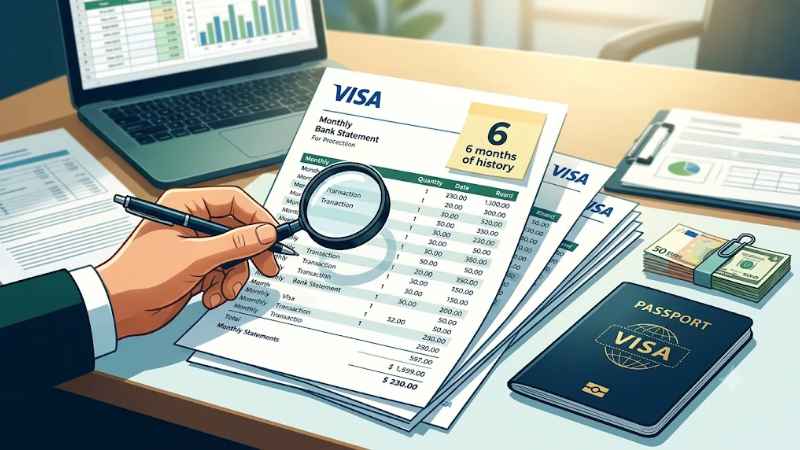
Ask ten people how much money you need in your account for a visa and you’ll get ten different answers. Most of them sound confident, and most of them are guesses. The truth is that a bank statement isn’t a number test. It’s a story about your finances, and the consulate reads it to answer one question: can this person pay for the trip and are they likely to return home? This guide explains what that means in practice.
What Officers Actually Look For
A visa officer isn’t checking whether you cleared a magic balance. They look at four things:
- Can you afford this trip? Your funds should reasonably cover flights, hotels, food and local travel.
- Does the income look real and regular? Salary credits or business income that arrive consistently over months.
- Do the documents agree with each other? Statement, salary slips, ITR and employment letter should tell the same story.
- Do you have reasons to return? Stable job, family, property or business in India.
A balance that was built up slowly over months reads very differently from a large deposit made a week before applying.
How Many Months of Statements?
Most Schengen applications ask for the last three to six months. Some consulates, often Germany and France, are generally more comfortable with six months. Many other countries accept three, but if you have six months of clean history, there’s rarely a reason to submit less. Other destinations such as the UK, Japan or the UAE have their own requirements, so always check the checklist for your specific visa.
Two practical rules apply almost everywhere:
- The statement should be recent, usually not older than about two weeks to a month on your appointment day, depending on the consulate.
- It should be stamped and signed by the bank, or downloaded and attested, with your name and account number clearly visible. Plain screenshots are risky.
How Much Balance Is “Enough”?
There’s no single official figure for Indian applicants. Each Schengen country publishes reference amounts, and across countries they commonly fall in the range of roughly €50 to €120 per day of stay, depending on the country and whether you’re staying in a hotel or with family. These are reference points, not guarantees of approval.
To get a sensible working figure for your own trip:
- Estimate your total trip cost (flights, hotels, food, local transport, activities).
- Check the destination country’s daily reference amount, which is available on its embassy or VFS page.
- Multiply by your days of stay, and make sure your funds comfortably exceed that.
- Include everyone you’re travelling with and any dependants whose costs you’re covering.
If your total feels tight, don’t try to inflate it. Instead, consider adding supporting funds such as a fixed deposit, mutual fund statement or a sponsor, if genuine.
What a Good Statement Looks Like
- Regular income. Salary or business credits arriving at similar times each month.
- A steady balance. Not drained to zero every month and not spiking just before the application.
- No unexplained large deposits. If you did receive a bonus, sale proceeds or a gift, explain it in your cover letter and keep the supporting paper.
- Name and details match your passport and application. Even small mismatches can raise questions.
- Consistency with your ITR and salary slips. The numbers should line up.
Common Mistakes
- Depositing a large sum just before applying. Officers notice it and may question the source.
- Submitting a statement from a rarely used account. A fresh or dormant account says little about your finances.
- Using screenshots or unattested printouts. Always check the consulate’s rule on stamping.
- Ignoring other documents. A strong balance doesn’t help if your ITR or employment letter contradicts it.
- Not explaining unusual entries. A short, honest line in the cover letter is better than leaving it to guesswork.
- Assuming a higher balance guarantees approval. Visa decisions depend on the whole file, and no agency can promise a result.
If Your Balance Is Low or Irregular
Don’t panic and don’t fake anything. Options that are genuine:
- Postpone your application by a few months and let a healthy balance build.
- Add other proofs of funds: fixed deposits, mutual funds, property documents or a recent bonus letter.
- Use a sponsor if the rules allow it, with their documents and a clear sponsorship letter.
- Choose a shorter or less expensive trip.
Providing false or manipulated documents can lead to refusal and can affect future applications, so avoid it completely.
Quick Checklist Before You Apply
- Statements for the required months, stamped and signed by the bank
- Name, account number and dates clearly visible
- Balance and income consistent with your ITR and salary slips
- Large or unusual credits explained
- Statement date recent enough for your appointment
- Matching information in the application form and cover letter
Need a Second Pair of Eyes?
Reading your own file is hard, because you already know what the story is meant to be. Travelistaan’s visa assistance can review your documents and point out gaps before you submit. We can’t guarantee approval, since the consulate makes the final decision. For official requirements, always check the embassy or VFS Global page for the country you’re applying to.
If you’re still planning the trip itself, you may find our guides on a Europe trip from Delhi and Japan for first-timers useful, or contact us with your dates and we’ll help you plan.